
The Small Business Owner's Guide to Working Smarter with AI
AI is the extra set of hands you've been waiting for, available 24/7, no salary required. You don't need a marketing department, a big budget, or a tech team to start. You just need to know where to begin.
Let's clear something up first: AI is not just asking ChatGPT to write things for you.
Most people picture a chatbot when they hear "AI." That's one tool in a much bigger toolbox and it's not even the most powerful one for small businesses.
What most people think AI is:
Typing prompts into ChatGPT
Getting a robot to write blog posts
Something that requires tech expertise
What AI actually is for small businesses:
Automating customer replies 24/7
Creating visuals without a designer
Analyzing customer feedback instantly
Running email campaigns on autopilot
The gap no one talks about
Here's the stat that should stop you in your tracks: 68% of small businesses say they "use AI", but only 25% have actually integrated it into their daily operations. (U.S. Chamber of Commerce / Teneo, 2025)
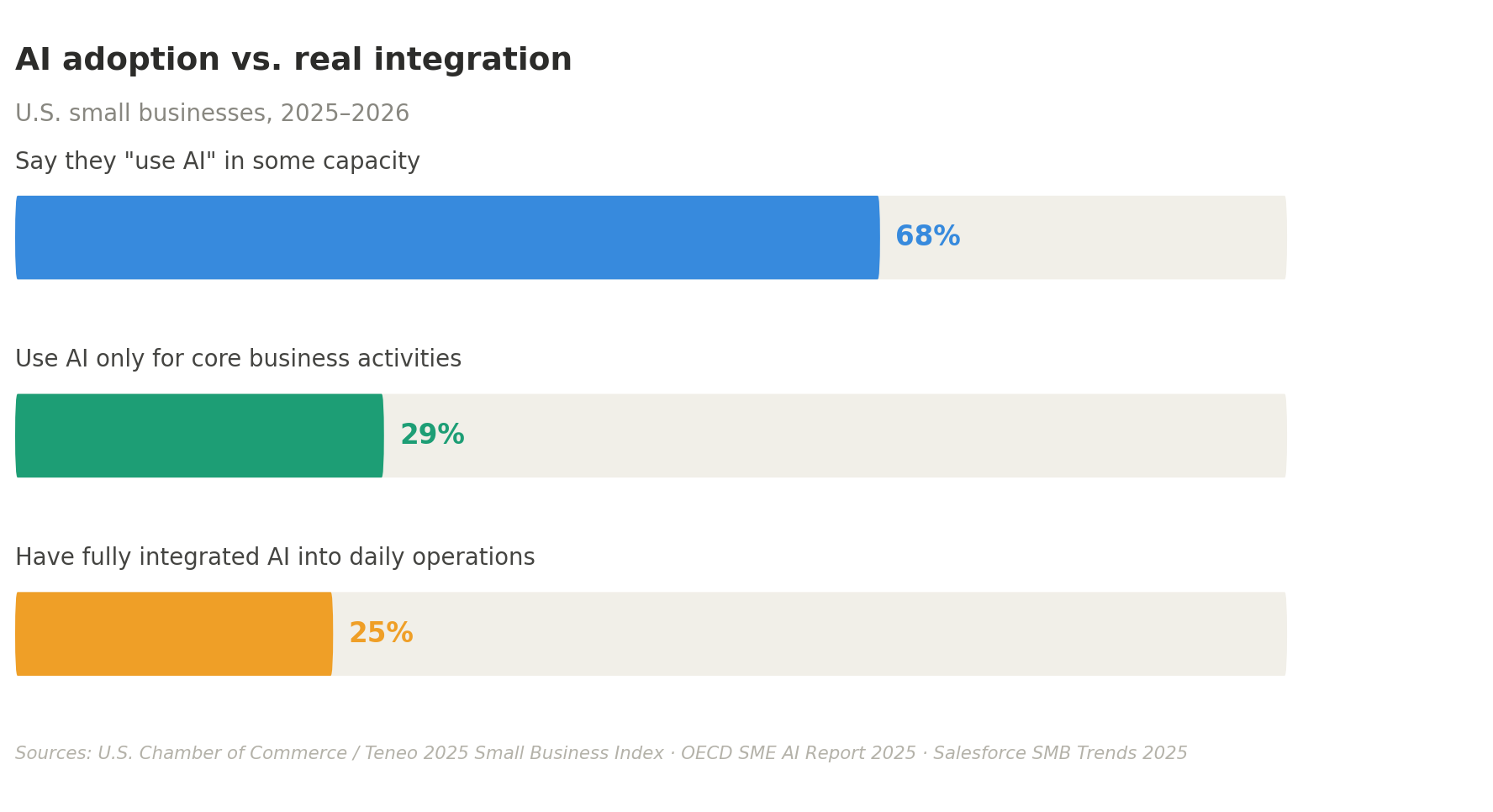
That gap is where the real opportunity lives. The businesses closing it aren't the biggest or most tech-savvy; they're the ones who decided to go beyond dabbling.
A few numbers worth knowing:
91% of small businesses actively using AI report a revenue increase — Salesforce, 2025
82% of very small firms still believe AI isn't applicable to their business; that's not a limitation, it's an education gap
Why AI isn't just for big brands
For years, sophisticated marketing automation was reserved for companies with dedicated teams and five-figure software budgets. That era is over. The same AI technology powering Fortune 500 campaigns is now available to the bakery owner, the freelance designer, or the local gym.
What matters now isn't how big your team is, it's how well you understand your customers and how consistently you show up for them. AI helps you do both.
6 ways small businesses are using AI right now
These are the most common marketing tasks where AI saves real time. And here's the good news: you don't need five different tools to cover them all. Many AI platforms handle several of these in one place, so start with one tool, see what it can do, and expand from there.
Content & Copywriting — Free to start
Write social captions, email newsletters, product descriptions, and blog posts in minutes.
Tools worth exploring: ChatGPT, Claude, Jasper
Social Media Planning — Free to start
Generate a full month of post ideas, captions, and hashtag sets tailored to your niche and voice.
Tools worth exploring: Buffer AI, Later, Hootsuite
Email Marketing — Under $20/mo
Draft welcome sequences, promotions, and follow-ups that sound like you, in a fraction of the time.
Tools worth exploring: Mailchimp AI, Klaviyo
Customer Research — Free to start
Paste in your reviews and ask AI to instantly summarize what people love and what needs work.
Tools worth exploring: ChatGPT, Claude
Visual Content — Under $20/mo
Create graphics, product mockups, and social imagery without a designer.
Tools worth exploring: Canva AI, Adobe Firefly
Customer Support — $20–50/mo
Answer FAQs, take bookings, and respond to inquiries around the clock — even when you're closed.
Tools worth exploring: Tidio, ManyChat, Intercom
Keep in mind, you don't need six tools. Platforms like ChatGPT, Claude, or even Canva's AI suite can handle writing, research, and basic visuals all in one place. Pick one, get comfortable, then decide if you need anything else.
We're focusing on marketing here, but AI goes much further. Operations, inventory, bookkeeping, hiring; there's an AI angle for all of it.
Making it Real
A week in the life: AI for a local restaurant
No marketing budget. No social media manager. No problem. Here's what one week looks like when a single AI tool, something as accessible as ChatGPT or Claude, is part of your routine.
Monday — Write 5 Instagram captions based on this week's specials and your restaurant's vibe. One prompt. Takes 2 minutes.
Tuesday — Draft a short email to your list announcing the new weekend brunch menu. Review, tweak, send. Under 5 minutes total.
Wednesday — Paste in 10 Google reviews and ask AI to write warm, on-brand responses for each. Batch it. Done in one sitting.
Friday — Ask AI to summarize patterns across your last 30 reviews — what do people love, what needs work? Better than reading every review yourself.
Total time invested: about 45 minutes for a full week of marketing. One tool. No expertise required.
Pro tip: The restaurant example works for any business. Swap "specials" for your service of the week, "brunch menu" for a new product launch, and "reviews" for customer emails or DMs. The workflow is the same.
The honest truth about AI in marketing
AI isn't magic, and it's not a replacement for knowing your customers. The businesses winning with AI are using it to amplify what's already working for their voice, their story, their relationships.
But let's be even more direct about something: AI will never replace the humans behind your business. Not fully. Not even close.
Here's what AI is genuinely great at: executing faster. Writing a first draft, scheduling posts, answering a routine question at 2 am, pulling patterns from a pile of reviews. It removes the grunt work so your team can focus on what actually moves the needle.
Here's what AI cannot do:
Set the direction. AI doesn't know your goals, your market, or why you started your business. That strategic thinking, who you're talking to, what you stand for, where you're headed, that's yours. A human has to own it.
Protect your brand. AI doesn't know when something feels slightly off, misses a cultural moment, or just doesn't sound like you. Your team does. Every piece of AI-generated content needs a human eye before it goes out; not because AI is bad at writing, but because no algorithm knows your brand better than you do.
Build the relationship. Your customers chose your business because of you, your values, your personality, and your care. AI can help you show up more consistently, but the relationship is still human-to-human. That's never going to change.
Read the room. Tone, timing, empathy; these are human skills. Knowing when not to send that promotional email because something is happening in your community, or when a customer needs a real conversation instead of a chatbot, AI won't catch that. Your team will.
Think of AI as the engine and your team as the driver. The engine makes everything faster and more powerful, but without a driver setting the direction, making the calls, and course-correcting along the way, it's going nowhere useful.
The businesses that will win with AI aren't the ones that hand everything over to it. They're the ones who use it to free up their people to do the work only humans can do: think, connect, create, and lead.
The golden rule: AI gives you a first draft, not a final answer. Always read what it produces, add your own touch, and make sure it sounds like you before it goes out the door. Your oversight isn't optional; it's the whole point.
Where to go from here
Start small. One tool, one task, one hour a week. The compounding effect of small, consistent wins is what separates businesses that grow from those that stay stuck.